


For nearly 50 years, Chuck E. Cheese has ruled the birthday-party circuit. With a 2020 bankruptcy in the rearview mirror and a new vision for expansion beyond arcade games, CEO Scott Drake is ready to level up.
His playbook: immersive entertainment, friction-free family fun, and ambitious new concepts with global potential. Here, Drake shares with The PRIZE where Chuck E. Cheese (CEC) is headed and what every attraction operator can learn from its comeback.
How do you ensure a nearly 50-year-old brand remains relevant?
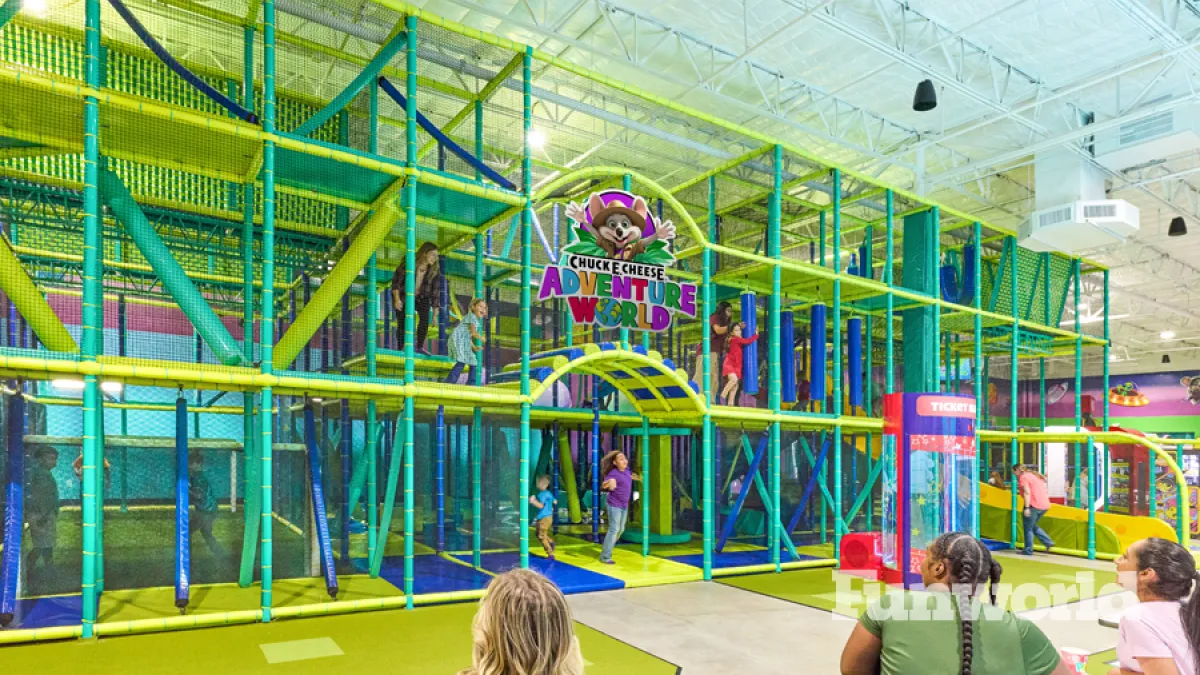
We have to be relevant to today’s kids, that means always evolving, always changing. Chuck E. Cheese has replaced most animatronics with video walls and interactive dance floors, digitized tokens and tickets, and introduced bounce zones and obstacle-course-style playgrounds. Active play now accounts for about 10% of store sales, and CEC is building on that demand with an accelerated U.S. rollout of Chuck E. Cheese Adventure World, its new indoor-playground concept.
What is Chuck E. Cheese’s “secret sauce”?
We have this incredible tenure with our teams. It’s not uncommon to meet employees in our stores who have been here for decades. I met somebody in Florida with more than 40 years and what I’ve realized is that’s the secret sauce. They want to be there, and it makes all the difference. They want to make kids’ days.
How has Chuck E. Cheese modernized the experience for children and parents?
We removed a ton of friction for parents. They used to have to haul around tickets, weigh them, put them in the ticket muncher, and keep track of tokens. We digitized all of that. Kids just tap a card. It’s easier for them and less friction for the parents.
As economic uncertainty faces consumers, how does the company adjust and focus on affordability?
We knew affordability was the hurdle. But birthday parties are the on ramp to the Chuck E. Cheese experience. People book the $99.99 birthday party (for a party of six children), but on average, they have about eight kids, and the full ticket is typically a little over $200. It isn’t a trade-down from $300 or $350 to $99. Birthday bookings have increased 40% over the past two years, while total revenue grew 15% from 2024 to 2025. It was a massive win-win.
What have you found the industry gets wrong about value?
When families go out, one of the primary things they want to know is: “How much are we going to spend?” They want expense certainty when they walk in the door. If they planned to spend $80—but spend $120—that’s great for you that day, but they also file it away: “I’m not going back.” That certainty of spend, knowing what they’re going to get and what it will cost, is vital.
How are you incorporating AI into a kid-focused business?
We’re not introducing AI face-to-face with kids. We don’t feel there are sufficient safety guardrails around that. Kids need fun. They need games. They need Chuck E. We’ll use AI to make parents’ lives easier, improve operations, and support back-end analytics, but it won’t be face-to-face with kids. Maybe someday, but not today, and not soon.
What do you think is the opportunity ahead?
We’re really an industry of one: a mini amusement park in a box. Adventure World is the future of Chuck E. Cheese. Once we have about a dozen open and some experience, we’ll know whether this can become 300 stores, 700 stores, or 900 stores in the U.S. [or] globally, it could be thousands.
Away from strategy, Drake is an enthusiastic champion of the company’s food, praising the stores’ fresh-made dough and proprietary sauce. His order: “It’s always a sausage pepper or sausage jalapeño.”
His go-to game? Rollerball, Chuck E. Cheese’s version of Skee-Ball, although he’s still working out what’s best: straight up or bouncing it off the side. Some executive decisions simply require more field testing.