


Funworld
Keeping It Clean In Aquatic Attractions
Maintaining Sanitation
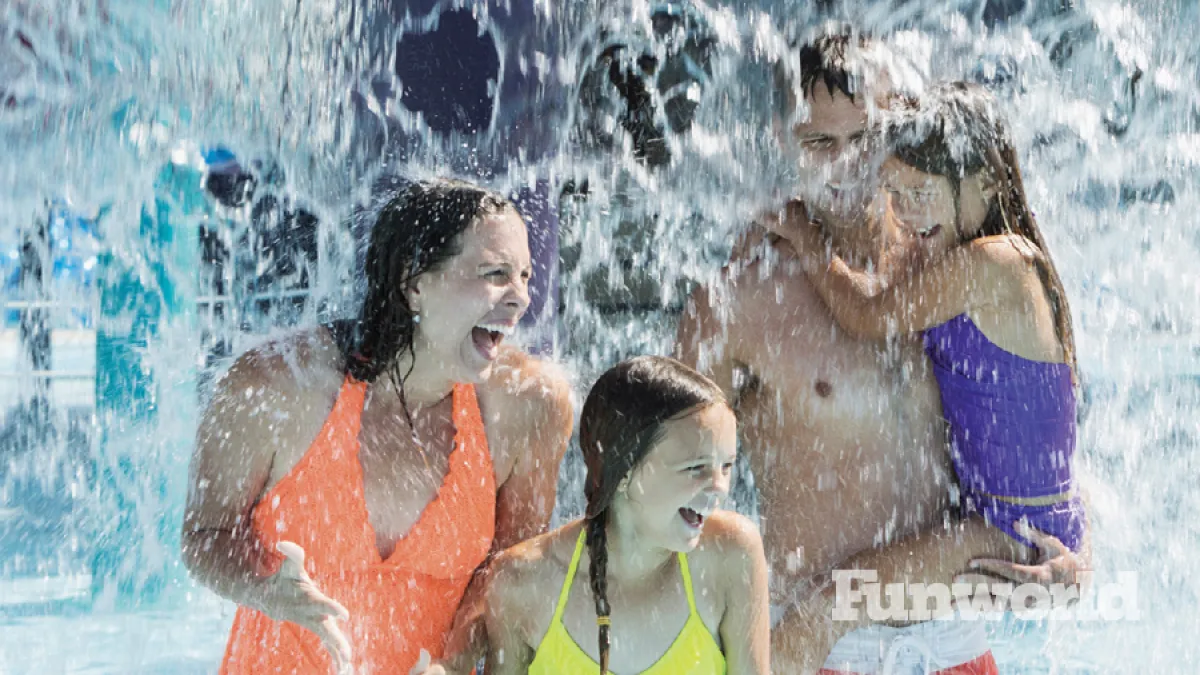
FEW EVENTS STRIKE HORROR IN THE HEARTS OF WATER PARKS OPERATORS faster than a code brown. Fortunately, by following stringent safety regulations with sanitation technology and chemistry, guests and operators alike can enjoy a high degree of confidence. Days spent in basin-style lagoons, water slides, surf parks, and classic swimming pools won’t be disrupted by unsanitary conditions with a little planning.
Field leaders from WhiteWater and Martin Aquatic spoke with Funworld about the latest developments in ensuring safe conditions at water attractions of all kinds, from state-of-the-art filtration systems to flocculent control and chemical standards of quality.
All innovations in aquatic-attraction sanitation are based on advances in the field of wastewater treatment. Once those technologies or chemistry applications move past the experimental development phase and “become competitive in terms of its costing, they come to market as some types of new products within the aquatics industry,” says WhiteWater Sales Engineer Evan Forman.
Widespread adoption of newer technologies has reduced the incidence of chemical burns suffered at swimming pools. When this happens, “it’s usually going to be at an older facility that’s using older distribution methods,” leading to spikes in chlorine concentration. Forman notes that the burns result from “considerations of the mitigation of certain risks, alongside the outcomes and the severity of those outcomes,” says Forman. Therefore, operators should devise a risk mitigation protocol that fits their budget and staffing parameters.
With the advent of more advanced, higher precision sanitation products, delivery systems, and technologies from companies like Pulsar and Clearflow, aquatic attractions designers and operators have more sophisticated options than ever to select from. As is so often the case, upgrades to systems like Pulsar’s offer “a higher level of control in the release of its chlorine, relative to where you have to measure it, treat it, and watch it filter through,” Forman explains, elaborating that these filters “and the way that they break down the chlorine, it’s more or less ensuring that the infusion of the treated water is consistent.” Pulsar’s delivery systems rely on Calcium Hypochlorite (Cal Hypo) briquettes rather than liquid chlorine.
Sometimes a classic method is the most appropriate choice for a project. Josh Martin, president and creative director at Martin Aquatic, notes that each project is unique, so “how you design your water treatment system is based on what the necessary support services are around you. We might use liquid chlorine on a project in Orlando because it can be delivered in bulk. Or we might use a version of a salt-chlorine generator with rock salt on a cruise ship or island.” This is because the product can be shipped in and stored easily, and it doesn’t degrade over time.
Every facility—and each facility type— follows its own safety standards for the wide variety of potential fecal incidents, Martin adds. Since his company works on so many high-volume projects, “we use computational fluid dynamic modeling, or CFD. We’re designing systems to circulate water and to target certain areas. If we’re working with a swim-up bar, we’re making sure that additional water and chemicals can go to that area, because we understand that by nature, people may not get out of the water when they’re at a bar drinking.” This realistic, nonjudgmental approach accounts for human behavior at the design stage, and it has enabled Martin Aquatic to design some attractions “where, even if you have a fecal incident, you may not be required to shut the entire body of water down if you have the proper CFD model and improved water chemistry.”
Another non-chemical method of water sanitation is flocculation: a process that electronically agitates water, encouraging minute particles of suspended matter—grass, insect remains, and sand, as well as effluvia—to condense into bundles of matter that can then be vacuumed or filtered out of the water. Flocculation, explains Forman, offers “a means to additionally clean the water even more than what was previously achievable through just pumping water in and out,” yielding the clearer water that attraction visitors expect to enjoy.
Filtration media and methods have also improved, Martin says, noting that while “regenerative media filters have higher upfront capital costs,” using them can make the difference between a pool remaining open or being down for several days. From an operator’s perspective, that downtime can ruin the chances of guests returning for another stay next year. Some of the latest filters “now filter particles down to one micron. They’re capable of capturing [the intestinal parasite] Cryptosporidium,” adding—at an expense—another layer of health and safety protection for guests and staff.
Surf parks and basins, with their ranges of 2.5 to 7 million of gallons of water depending on size, are the largest aquatic attractions by volume. The difference, Martin says, “is bather load and how people use and interact with that water.” One of the largest surf parks in the world is Kelly Slater’s Surf Lagoon, but there are usually just “20 to 30 people in the water at any one time over acres.” Martin’s in-progress endless surf lagoon in Melbourne, Florida, will accommodate a maximum of 60 people at any one time. By comparison, the basins at Carnival Cruise Lines’ Celebration Key island hold “4,000 people per three acres—a massively different amount of bather load, organics, and sunscreen.” Despite the substantial disparities in bather load, Martin says, the sanitation approach is the same, “because ultimately, you still have the same risk of bacteria and amoebae growing in those bodies of water if they’re not treated correctly.”
Looking ahead to future innovations in this sector of the industry, Martin notes that many of the cutting-edge technologies are likely to be deployed outside of the United States due to the amount of time and costs are required to navigate regulations, plus the process of securing a National Science Foundation listing. Consequently, projects in regions like the Middle East and Europe benefit from “using different chemical generators and different dispersion methods,” Martin explains, adding this is because these regions have regulations allowing their use.
The global economy is an ever more confounding variable, as well. As of this reporting in June 2026, the Strait of Hormuz in the Middle East remains closed, and even if it reopens soon, most economists anticipate that it will take six to eight months for the flow of goods to return to normal. Aquatic attractions are best served to plan ahead for continued disruption in the supply chain and potential added costs to maintain their safe operating standards.
Follow IAAPA for news and event announcements in your favorite social media apps
Connect with the Real Stories Behind the Fun
Follow our social media for authentic stories, special moments, and behind-the-scenes looks from the attractions world.


