


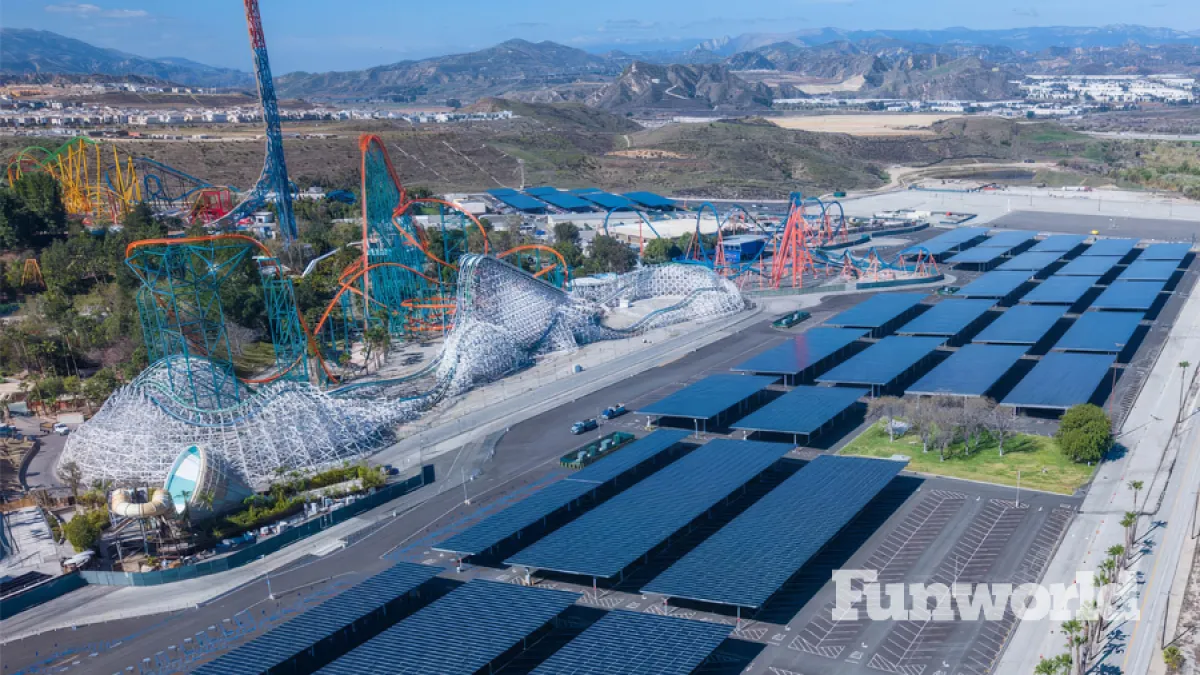
The majority of Funworld readers will “get a charge” from the following prose during a time when many Six Flags properties hibernate for winter. What’s not on hiatus? The sun—and vast acreage of solar arrays installed atop Six Flags’ parking lots across that continue to generate power even when the gates are closed.
“We are actually the largest carport solar energy supplier in the United States of any private company,” says Jason Freeman, senior vice president of corporate operations at Six Flags.
The regional operator first began the process of capturing the sun’s rays in 2014; Six Flags Great Adventure in Jackson, New Jersey, came online in June 2019.
“The energy goes out to the grid—it doesn't feed the park. But, we produce enough energy to offset 80-90% of what we're using,” Freeman explains. The installation is known as a behind-the-meter (BTM) project, meaning the solar panels are interconnected into the regional utility provider’s electrical grid. Beyond the sustainable strides, the benefits are vast: Six Flags achieves “millions of dollars in savings” in their annual power bill according to Freeman,; guests who park under solar canopies return to a car shaded from the blistering sun; a network of security cameras can be installed under the solar arrays; and the needed infrastructure requires each parking lot to be freshly repaved—often at no cost to Six Flags. How does Six Flags do it? Research.
“It is the wild west out there and you really have to align yourselves with the right companies,” Freeman recommends.
Dawn of a New Idea
Freeman hired clean energy consultant Kyle Goehring in 2016 to navigate the solar installation process—from government regulations and public utility partnerships to the evaluation and selection of the solar PV (photovoltaic) developers to complete installation and activation.
“A portfolio approach began in 2016. Various iterations of the number of parks and the bundling of projects occurred as Six Flags’ senior leadership evolved, underscoring the importance of clean energy and the beneficial economics associated with these solutions,” Goehring explains. “Ultimately, we progressed with the parks that offered the greatest financial benefits at the time.”
Six Flags Discovery Kingdom located northwest of San Francisco came online in 2019; Six Flags Magic Mountain north of Los Angeles flipped the switch in 2025; and Six Flags Great America north of Chicago is now under contract. Freeman says Six Flags with its many properties (including the legacy Cedar Fair parks) has the capacity to become the No. 1 for-profit producer of on-site solar energy in the United States.
Illuminating the Future
With the cost of power expected to rise in the next two years, investing in solar can produce “millions of dollars in energy savings for each park,” according to Freeman.
The projects are under a power purchase agreement (PPA) model structure, according to Goehring. “Six Flags has not directly invested any money [$0 spent] on the solar projects initially or over the term of the agreement [20+ years] for the ongoing maintenance and operations,” he says. “These savings can be allocated toward additional park enhancements, improvements, or applied to previously underinvested areas.”
Goehring recommends those attractions interested in investing in solar commission a study evaluating future utility pricing, needed leadership approvals (park and senior-level), and identify available areas for onsite clean energy technologies.